

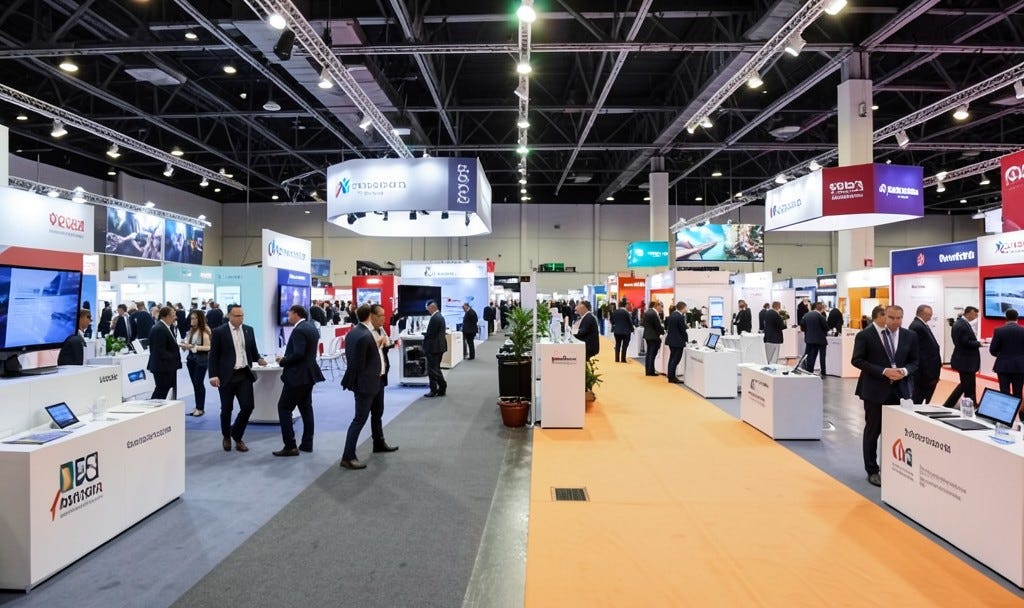
A show floor opens this morning.
For the next four days, the visible product of months of work is a space people walk through, a handful of conversations, and some photos. That’s the part that exists publicly. It’s a fraction of a percent of what went into it.
I’ve come to think trade shows are the purest example of what this newsletter is about. The ratio of invisible work to visible outcome is extreme, and almost nobody outside the team has any idea.
I started preparing for this show at the end of May.
Four months. And still, the last two weeks are where it all compresses — where deadlines that looked comfortable in June arrive and pass in the same afternoon, and where things nobody remembered to mention surface all at once.
That’s the part that’s hard to explain from outside it. The problem isn’t the volume of work. It’s that the work you planned for and the work that actually appears are two different lists.
This time it was a creative asset that had been requested months earlier. The request existed. What didn’t exist were the specifics — what it actually needed to be, what it needed to include, who it was for. Everyone assumed that was settled. Nobody had the same version of settled in their head.
So a project that read as simple turned into something considerably larger, in the final two days of prep. It meant reaching out to our overseas team, who had reasonably already left for the weekend, and going looking for source assets I was genuinely hoping existed. They did. The team turned them around fast, and the thing got built at the eleventh hour. Nobody who sees it will know what the last forty-eight hours looked like.
Looking back, the honest diagnosis is that I didn’t know what I didn’t know. It wasn’t anyone’s failure. It was two different assumptions about what was expected, neither of them ever said out loud. I wrote a few weeks ago about the difference between a request and a brief. This is what it costs when you find out late.
The list of what goes into four days is long. The part that gets you is never on it.
What’s underneath four days
An incomplete list of what exists before the floor opens:
Booth design and layout revisions. Structural approvals. Graphics produced at sizes most people never work in, at resolutions that break laptops. Color proofed against a physical sample, because a screen lies. Product assets photographed, retouched, cleared. Video edited for a screen you’ve never seen in a room you’ve never stood in, with no audio, in bright light, playing on loop to people watching for eleven seconds.
Copy written, reviewed, revised, legal-checked, revised again. Signage. Wayfinding. Badge scanners nobody tests until they don’t work. Printed materials ordered at a quantity that’s a guess. Giveaways sourced months early because production and shipping don’t care about your timeline.
The meeting schedule. The staff briefing. The demo script and the three people who need to know it cold. The follow-up sequence built before the show so it can actually go out during the show. Shipping manifests. Load-in windows. The contingency box with tape, adapters, a backup drive, and a printed copy of everything digital.
And the decisions. Hundreds of them, most made under a deadline, most invisible, each one a place where a slightly worse choice would have compounded.
The invisible work is the work
There’s a version of this observation that turns into complaint, and I want to avoid it — partly because complaint isn’t interesting, and partly because it misses what’s actually true.
The invisible work isn’t overhead attached to the real thing. It is the thing. The booth someone walks through is the output of it, the way a finished building is the output of engineering nobody sees.
What makes trade shows clarifying is the hard stop. There’s no slipping the date. The floor opens Monday whether you’re ready or not, and that constraint reveals exactly how good your systems are. Teams with reusable assets, clear decision rights, and a real timeline are calm in week two. Teams without them are heroic in week two — and heroism, as I keep coming back to, is a symptom rather than an achievement.
What I’ve learned to do earlier
Three things move more than anything else, and all three happen months out.
Lock the message before the layout. Design decisions made while the message is unsettled get remade. Every time.
Produce the derivative assets in the same pass as the primary ones. The social cuts, the sales one-pager, the follow-up graphics, the post-show recap shells. Doing them during the main production window costs a fraction of what it costs to come back to them in the last week, when nobody has the hours.
Build the follow-up before the show. The single biggest waste at trade shows isn’t in the booth. It’s the leads that sit for eleven days afterward while an exhausted team recovers, by which point the conversation has cooled and the person barely remembers you. If the sequence exists before you leave, it goes out on day two.
Ask what "done" means while there's still time to hear the answer. A request is not a spec. If something has been on the list since June and nobody has described what it actually needs to contain, that's not a project on track — it's a project nobody has started defining yet. The question that would have saved me two days was available in June for free.
What actually shows
If it goes well this week, what people will see is a space that feels considered. Clear. Easy to understand at a glance. Someone who knows the product standing in it, ready to talk.
They will not see the months. That’s the point — visible effort is usually a sign something didn’t get resolved early enough.
The work behind the work isn’t a complaint about being unappreciated. It’s just an accurate description of where the work is.
Question for you: If you’re at a show this week — or you’ve done one — what’s the one thing you always pack that experience taught you to bring? I’ll take the practical answers.